EAST COAST SKIFF
We have five East Coast Skiffs at Stella Maris and race them throughout the summer at East Coast Regattas. The season begins in late May and runs all the way to August Bank Holiday with the finale in Wicklow. You can see our upcoming regattas HERE
Racing starts at under 12 age level for boys and girls leading all the way to adult where there are three grades: Intermediate, Junior and Senior. There are also classes for Mixed (male & female) and Veteran (over 45’s). Crews comprise of four rowers and a coxon. 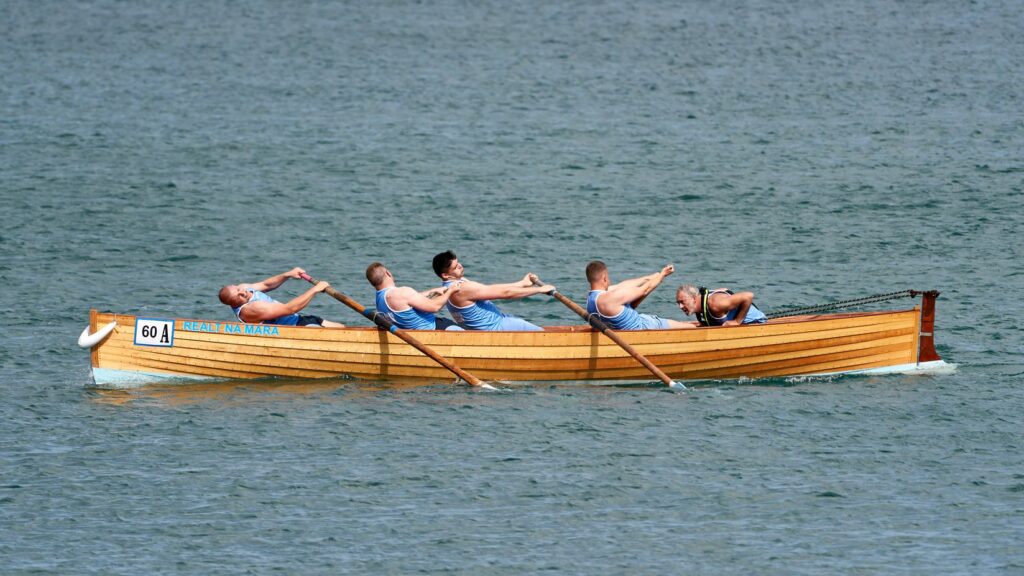
The East Coast Skiff is a 25ft long double ended clinker-built rowing boats based on the East Coast of Ireland. It is widely raced by rowing clubs based in coastal communities from Balbriggan in North Co. Dublin to Arklow in South Co. Wicklow. In the 19th and early 20th centuries, the skiff was the work horse of the old Hobblers who used to race out to sea off the Dublin and Wicklow coasts in order to meet incoming ships. Their challenge was to be the first one to land their hooks on the inbound vessel where the victorious crew would earn the right to Pilot the vessel into port and win the contract to load / unload the ships’ cargo.
This was an extremely dangerous means of earning a living with crews having to put to sea in often dangerous weather conditions and often having to spend days at a time at sea in open boats with no shelter in order to give themselves the best chance of landing their catch. With advances in maritime technology in the second half of the 20th century, the Hobblers of old soon found themselves surplus to requirements and the trade of Hobbling soon became but a distant memory. Although Hobbling faded into the past, the Coastal Communities love of skiff racing continued. The heavy and often unwieldly skiffs of old evolved into racing machines, lighter and sleeker and more suited to racing than the workhorses of old.
As had happened with other branches of Irish Coastal Rowing, competition developed not just in the fitness and skills of the crews but also in the speed and agility of the boats meaning that often races were being won not because the winning crews were faster, stronger and fitter but because their boats were faster, lighter and more seaworthy. The East Coast Rowing Council which is the Class Association of the East Coast Skiff finally said enough was enough and decided to opt for a standard design and ruled that from then on all skiffs built after the introduction of this rule would have to be built in accordance with the stated guidelines.